
BMW 7 E32 Wiring Diagram. Electrical System
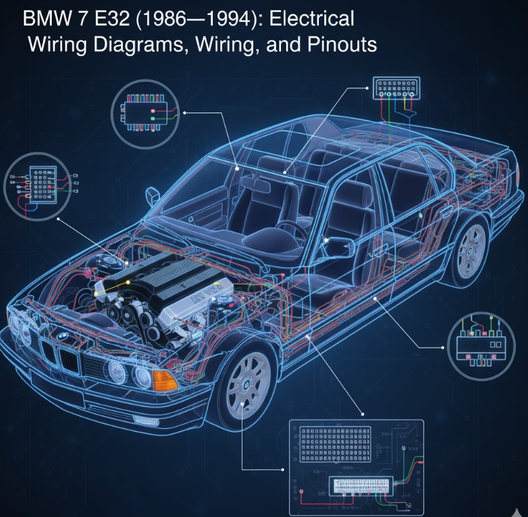
All electrical diagrams for the BMW E32 (1986–1994). Detailed pinouts for the DME/ECU, ABS, engine wiring (M30, M60, M70), sensors, and relays. Download the electrical diagrams.
The BMW 7 Series E32 was equipped with the following gasoline engines:
6 Cylinder:
- M30B30: 3.0 L (730i, 730iL).
- M30B35: 3.5 L (735i, 735iL).
- M60B30: 3.0 L (late 730i models, since 1992).
V8:
- M60B40: 4.0 L (740i, 740iL, since 1992).
V12:
- M70B50: 5.0 L (750i, 750iL). This was BMW's first production V12 engine.
BMW 7 E32 Electrical Troubleshooting Manual
1987 BMW 735i (E32) Electrical Troubleshooting Manual Download
1988 BMW 735i - 735iL - 750iL Electrical Troubleshooting Manual.pdf
Engine M70B50, M30B35 Download
1991 BMW 735i - 735iL - 750iL Electrical Troubleshooting Manual.pdf
Engine M70B50, M30B35 Download
Electrical System General – BMW E32 88-94 Download
Electrical Component Locations – BMW E32 88-94 Download
Switches and Electrical Accessories – BMW E32 88-94 Download
Exterior Lighting – BMW E32 88-94 Download
Airbag System (SRS) – BMW E32 88-94 Download
Electrical Component Locations – BMW E32 88-94 Download
Electrical Wiring Diagrams – BMW E32 88-94 Download
Typical Electrical and Wiring Issues in the BMW 7 Series E32
1. Engine Management & Starting Issues (DME/Motronic)
-
DME Main Relay Failure: The main relay often fails due to heat and age, leading to intermittent or complete no-start conditions (cranking but no ignition/fuel).
-
Crankshaft Position Sensor (CPS) / Camshaft Position Sensor (CMP) Failure: These sensors (especially the CPS) are prone to failure, often resulting in the engine dying when hot or being difficult to start.
-
Wiring Harness Degradation (Aging Insulation): Especially prevalent in the engine bay and near high-heat areas. The insulation on older wiring (particularly in cars built before the early '90s) can become brittle and crack, leading to short circuits or open circuits.
2. General Wiring & Power Distribution
-
Fuse Box/Relay Panel Corrosion: Water intrusion (especially near the passenger side footwell and rear fuse box) can cause corrosion on terminals, leading to various intermittent issues (e.g., inoperative electric seats, windows, or central locking).
-
"Glovebox Flashlight" Battery Leakage: The rechargeable battery in the glovebox flashlight is notorious for leaking acid onto the main wiring harness running beneath it, causing corrosion and shorts that affect the interior electronics.
-
Ground (Earth) Points: Poor grounding points, particularly for the engine and chassis, can cause erratic behavior in lights, gauges, and electronic control units (ECUs).
3. Interior & Convenience Electronics
-
Window Regulators and Wiring: The wiring harness that passes through the door hinge area is constantly flexing, making it susceptible to broken wires, which causes power windows (or mirrors) to stop working.
-
Central Locking System (ZV): Issues often arise from failing central locking actuators or broken wiring in the tailgate/trunk lid hinge, leading to intermittent locking/unlocking problems, particularly on the 750iL models.
-
Instrument Cluster (IC): Common issues include failing SI (Service Interval) board batteries (on pre-1991 models), leading to corrupted mileage data or inoperative gauges.
-
Heater/Climate Control (IHKR/IHKA): Failure of the Final Stage Unit (FSU), also known as the "Hedgehog," causes erratic blower motor speed or complete fan failure.
4. Trunk/Tailgate Wiring (750iL Specific)
-
Tailgate Wiring Loom: The large wiring loom that runs through the hinge of the trunk (especially important on the 750iL with its complex equipment) frequently experiences fatigue and wire breakage due to the constant opening and closing, affecting trunk lights, license plate lights, and central locking.
einars (Monday, 15 December 2025 21:16)
730 wiring diagram ?